Strait of Hormuz explained: oil, gas and your fuel prices
The Strait of Hormuz explained: where it is, how much oil and LNG passes through, why trouble there lifts fuel prices, and past crises from 1979 to 2026.
Why it matters
When ships are threatened in this narrow waterway, the world oil price rises, and that reaches the price of gasoline, diesel and jet fuel wherever you live.
Before the 2026 war, one in every five barrels of oil the world used passed through a channel 21 nautical miles (39 kilometers) wide. That is the Strait of Hormuz, and in October 2026 it is again the most watched water on Earth.
Quick answer: The Strait of Hormuz is the narrow sea passage between Iran and Oman that links the Persian Gulf to the open ocean. About 20 million barrels of oil a day, and close to a fifth of the world’s liquefied natural gas (LNG), moved through it in 2024 and 2025, according to the US Energy Information Administration (EIA) and the International Energy Agency (IEA). There are few other routes, so any threat to ships there lifts the world oil price, and later the price of gasoline, diesel and jet fuel.
The reason it is in the news now is a war. Since US and Israeli strikes on Iran began on 28 February 2026, Iran has restricted traffic through the strait, requiring ships to seek its permission and targeting vessels that use a southern route near Oman, AFP reported. The United States answered with a naval blockade of Iranian ports. On 23 October, Brent crude, the international oil benchmark, closed at $116.72 a barrel, its highest since April. A day later, Iran’s armed forces chief said US warships would not be allowed into the Gulf “under any circumstances.”
Is the strait open in October 2026?
Partly, and the two governments describe it in opposite terms. President Donald Trump says the United States now controls the strait. Iran says it will reopen the waterway only when Washington lifts its blockade, a condition Trump has rejected, CBS News reported.
Ship-tracking counts differ, partly because many vessels switch off their location signals, but public data such as the IMF’s PortWatch series show traffic far below its prewar level.
A narrow door with eight countries behind it
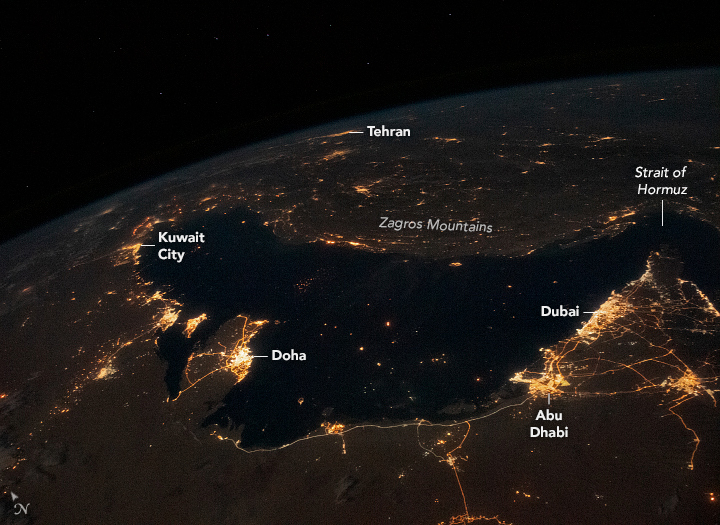
The strait sits between Iran to the north and Oman’s Musandam Peninsula to the south, joining the Persian Gulf to the Gulf of Oman and the Arabian Sea. Eight countries border the Gulf: Iran, Iraq, Kuwait, Saudi Arabia, Bahrain, Qatar, the United Arab Emirates (UAE) and Oman, NASA’s Earth Observatory notes. For a tanker loading at Ras Tanura, Kuwait or Basra, there is no other way to the open sea.
Ships keep to two lanes, one inbound and one outbound, each 2 miles wide with a 2-mile buffer between them, according to the IEA. The largest crude tankers can use them. Those lanes lie in Omani waters, a detail that matters more than it sounds, as the section on the law of the sea below explains.
Twenty million barrels a day, by the agencies’ count
The two main energy agencies use different years but land in the same place.
| Measure | Figure | Year | Source |
|---|---|---|---|
| Oil (crude and products) | about 20 million barrels a day | 2024 | EIA |
| Oil (crude and products) | 19.9 million barrels a day | 2025 | IEA |
| Share of world oil use | about 20% | 2024 | EIA |
| Share of world seaborne oil trade | about 25% | 2025 | IEA |
| LNG | just over 112 billion cubic meters, about a fifth of world LNG trade | 2025 | IEA |
| Crude and condensate going to Asia | 84% | 2024 | EIA |
Source: EIA Today in Energy, June 2025; IEA Strait of Hormuz factsheet, February 2026.
Saudi Arabia is the biggest single shipper, sending 5.5 million barrels of crude a day through the strait in 2024, according to EIA figures. China, India, Japan and South Korea together took 69% of the crude and condensate. Qatar sends about 93% of its LNG exports through Hormuz and the UAE about 96%, the IEA says, and most of that gas goes to Asia: 83% in 2024 by the EIA’s count, almost 90% in 2025 by the IEA’s.
The United States buys relatively little through the strait, about 0.5 million barrels a day in 2024, or around 7% of its crude imports, according to the EIA. American drivers still pay for trouble there, because oil trades on a single world market.
Two pipelines and a gap
Saudi Arabia’s East-West pipeline runs from Abqaiq, near the Gulf coast, to Yanbu on the Red Sea, with a design capacity of 5 million barrels a day. The UAE has a line from its onshore fields to Fujairah on the Gulf of Oman, rated at about 1.5 to 1.8 million barrels a day. Both already carry oil in normal times, which limits how much more they can take. The EIA estimated about 2.6 million barrels a day could be diverted in a crisis; the IEA puts the spare room at 3.5 to 5.5 million. Either figure is well short of 20 million.
For LNG there is no way around at all. Qatar’s gas leaves by tanker, through the strait, or it does not leave.
That is why Yanbu keeps appearing in the news. The port has let Saudi Arabia keep exporting much of its crude during the 2026 crisis, Kuwait Times reported, and on 24 October Saudi air defenses intercepted a Houthi missile aimed at it. Our report on the latest US-Iran tensions covers that weekend.
Who controls the water? Transit passage and Iran’s reading of the law
At its narrowest, between Iran’s Larak Island and Oman’s Great Quoin Island, the strait is covered entirely by the two countries’ 12-mile territorial seas. There is no strip of high sea in the middle. So the question of who may pass, and on what terms, is a legal one before it is a military one.
The 1982 UN Convention on the Law of the Sea (UNCLOS) created a right of “transit passage” through international straits. Ships and aircraft, warships included, may pass without asking permission, and the coastal state may not suspend that right. Ordinary territorial waters carry only the weaker right of “innocent passage,” which a coastal state can regulate more tightly.
Iran signed UNCLOS in 1982 but never ratified it, and the UN’s list of parties confirms it is not one. On signing, Iran declared that only states party to the convention could claim its new rights, transit passage included. A 1993 Iranian maritime law requires warships, submarines and nuclear-powered ships to get permission before entering its waters. Oman, which ratified on 17 August 1989, also declared that foreign warships need prior permission in its territorial sea.
The United States has not ratified UNCLOS either. It argues that transit passage is customary international law binding on everyone, and most maritime nations agree. When Iran’s armed forces chief says US warships will not enter the Gulf, he is restating, in military terms, a legal position Tehran has held for more than 30 years. Washington’s position is that the right of passage does not depend on Iran’s consent.
How a threat in the Gulf becomes a price at the pump
Prices move on risk, often before a single barrel is lost. Oil is traded for future delivery, so when a disruption looks more likely, buyers pay more today to lock in supply. Shipping reacts too: when a route looks dangerous, fewer owners send tankers and insuring a voyage costs more.
Brent’s close of $116.72 on 23 October followed claims by Iran’s Revolutionary Guards that several tankers had been hit or struck mines near the strait, and Houthi attacks on Saudi Arabia, CNBC and other outlets reported.
Governments can soften a spike with emergency stocks. On 11 March 2026 the IEA’s 32 members agreed to make 400 million barrels available, the largest release in the agency’s history and more than double the 182 million barrels released in 2022. That sounds vast, but it equals about 20 days of the strait’s normal flow.
In the United States, crude made up about half the retail price of gasoline in 2025, according to the EIA.
| Part of a gallon of US gasoline | Share in 2025 |
|---|---|
| Crude oil | about 51% |
| Distribution and marketing | about 18% |
| Taxes | about 17% |
| Refining | about 14% |
Source: EIA, Factors affecting gasoline prices; NACS.
Key figure: A barrel holds 42 US gallons. So every $10 rise in the price of a barrel adds about 24 cents to the cost of the crude inside each gallon, before refining and tax.
The pass-through is not symmetrical. In a study published in the Quarterly Journal of Economics in 1997, economists Severin Borenstein and A. Colin Cameron, with Richard Gilbert, found that US retail gasoline prices reacted more quickly to increases in crude than to decreases: rises showed up at the pump within about four weeks, falls took about eight. Economists call this “rockets and feathers.” For a driver, it means a calm week in the Gulf does not bring prices down as fast as a bad week pushed them up.
AAA put the US national average for regular gasoline at $4.27 a gallon on 22 October 2026, and said autumn prices this year were the highest on record for the time of year. Outside the United States the pattern holds, though the size of the jump depends on local fuel taxes and the exchange rate against the dollar. Energy costs also feed into inflation, which central banks weigh when they set interest rates.
Fear moves prices more than lost barrels
History suggests the price reaction depends less on how much oil is lost than on how frightened buyers are and how much spare oil exists elsewhere.
In the 1979 shock, Iran’s output fell by 4.8 million barrels a day by January 1979, about 7% of world production, according to the Federal Reserve’s history of the episode. Other producers made up part of the gap, and net world supply fell by roughly 4%. Prices still more than doubled between April 1979 and April 1980. The Fed’s account points to precautionary buying and hoarding by people who feared worse to come.
The Tanker War of the 1980s shows the opposite case. Iraq carried out 283 attacks on ships and Iran 168, according to figures from the US Naval Institute, and well over 100 sailors were killed. Yet oil prices fell, and in 1986 alone they roughly halved, from about $27 a barrel to below $10. The world was awash with crude: demand in rich countries had dropped, new fields in the North Sea, Alaska and Siberia were producing, and in 1985 Saudi Arabia stopped holding back its output. Hundreds of attacks did little to prices when there was oil to spare.
The 2026 shock met a tighter setup: 20 million barrels a day through one strait, bypass pipelines that cover a fraction of it, and no bypass at all for Qatar’s gas.
What the war-gamers got right, and what they missed
In 2008, the journal International Security published “Closing Time,” Caitlin Talmadge’s study of whether Iran could close the strait. It concluded that if Iran combined its mines, anti-ship cruise missiles and land-based air defenses, it could halt or impede traffic for a month or more, and that US efforts to reopen the waterway would likely turn into a sustained, large-scale air and naval campaign.
The 2026 crisis has now run for eight months, well beyond the “month or more” the study described. And Iran has not needed to seal the strait completely. A permission regime, selective attacks on ships using routes it calls illegal, and the reluctance of owners and insurers to send tankers into danger have done much of the work. The study’s focus was on whether Iran could physically block the channel. The harder problem for a navy has turned out to be a strait that stays technically open while most ship owners decide it is not worth the risk.
Earlier crises in the strait
- 1981 to 1988: During the Iran-Iraq war, both sides attack ships in the Gulf, a campaign known as the Tanker War.
- 24 Jul 1987: The US Navy begins escorting reflagged Kuwaiti tankers under Operation Earnest Will.
- 14 Apr 1988: The US frigate Samuel B. Roberts hits a mine in the Gulf. The ship stays afloat and no one is killed.
- 18 Apr 1988: In Operation Praying Mantis, US forces strike two Iranian oil platforms and sink or cripple several Iranian naval vessels.
- 19 Jul 2019: Iran’s Revolutionary Guards seize the British-flagged tanker Stena Impero in the strait. It is held for more than two months.
- 28 Feb 2026: US and Israeli strikes on Iran start a war, and Iran restricts traffic through the strait.
- Apr 2026: A ceasefire ends the heaviest fighting, and the US imposes a naval blockade on Iranian ports.
- 18 Jun 2026: After a US-Iran memorandum of understanding, the US military says it has lifted the blockade.
- Summer 2026: The deal unravels, with each side accusing the other of violations, and a US counter-blockade returns.
How to read the next headline from Hormuz
Iranian statements that tankers were hit, and US statements that traffic is flowing, usually arrive before any independent data. The more reliable signals come later: transit counts from ship trackers, insurers’ decisions on cover, and whether Brent holds its gains once markets reopen.
Watch for: any change to the US blockade of Iranian ports, which Iran has named as its condition for reopening; attacks near Yanbu, the main bypass for Saudi oil; and the Brent price. Every $10 a barrel is worth about 24 cents a gallon in crude costs.


